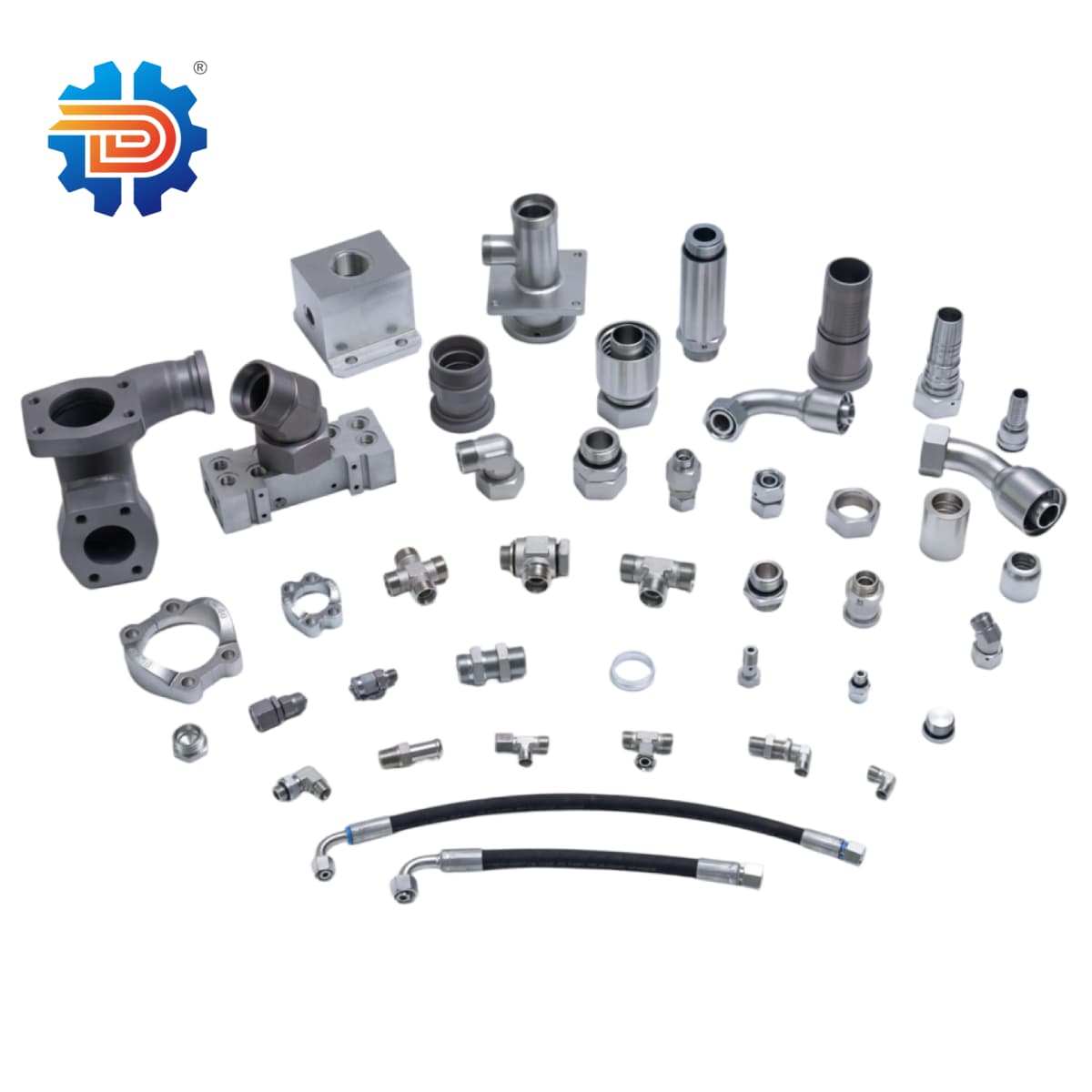
Precision-engineered fastening nuts designed exclusively for power steering hose assemblies. Featuring high-strength forged construction and secure thread engagement, these nuts ensure leak-proof fluid transfer in automotive steering systems. Available with optional zinc-nickel alloy surface treatment for maximum corrosion resistance and extended service life.
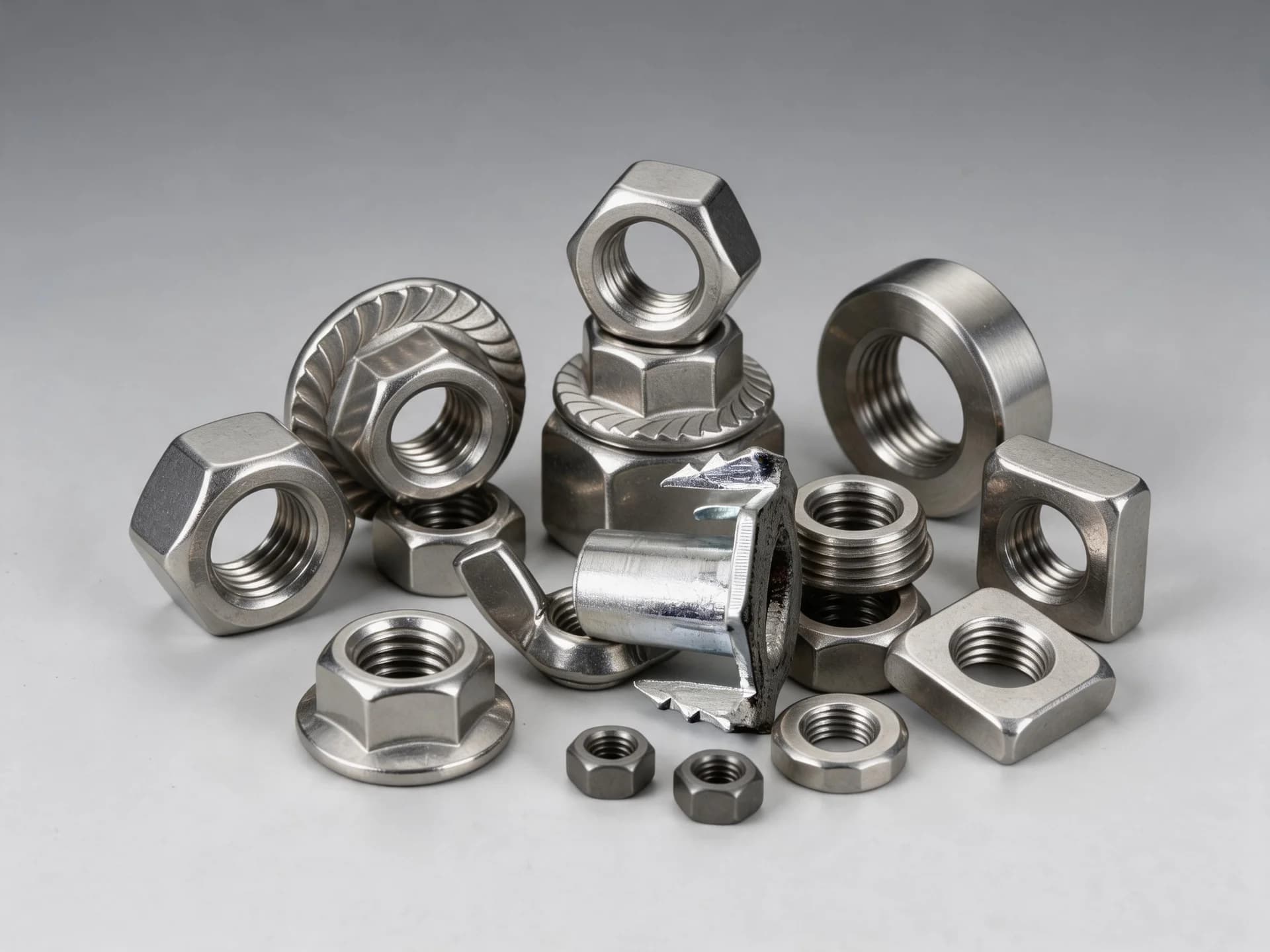
Industrial nuts — hex nuts, lock nuts, flange nuts, pronged tee nuts, cap nuts, and specialty threaded fasteners — are the critical mating components of every bolted joint, working together with bolts, screws, and studs to clamp assemblies across industries from flat-pack furniture and structural construction to heavy equipment, automotive, and aerospace. Often treated as a commodity but actually engineering-critical, the right nut must match the bolt grade, thread standard, environment, and service load to prevent loosening, thread stripping, or fatigue failure. This guide covers hex nut types, lock and jam configurations, pronged tee nuts for furniture, flange and weld nuts, thread standards (ISO / UNC / UNF / BSW), property classes (04 to 12), materials, finishes, applications, and selection rules — so you can specify the right nut for any fastening program from knock-down cabinets to bridges.
An industrial nut is an internally threaded fastener designed to mate with the external thread of a bolt, screw, or stud to clamp two or more parts together. Unlike the bolt (which provides the clamping force through tension), the nut provides the reaction face, the thread engagement length, and — in many designs — the locking mechanism that resists vibration-induced loosening. The four engineering properties that define any nut are thread fit, proof load, prevailing torque (for lock nuts), and surface corrosion resistance, all of which must be selected as a matched set with the bolt.
DA Fluid supplies the full industrial nut portfolio — from M4 pronged tee nuts for knock-down furniture to M64 heavy hex structural nuts for bridges — in carbon steel (Property Class 04 to 12 per ISO 898-2), stainless steel (A2-70 / A4-80 per ISO 3506-2), zinc die-cast, brass, and specialty alloys, conforming to the standards of DIN, ISO, ANSI/ASME, JIS, BS, and GB with full lot traceability under ISO 9001 and IATF 16949 quality systems.
Our nut catalog covers every major configuration used across furniture, construction, heavy industry, automotive, and structural applications:
DIN 934 / DIN 936 / ISO 4032 / ISO 4035 / ASME B18.2.2 / ASTM A563. The most common nut family — six-sided pattern for wrench access. Regular hex for general use; heavy hex (thicker section) for high-strength structural joints paired with ASTM A325 / A490 bolts. M1.6–M64.
DIN 985 / DIN 980 / ISO 7040 / ISO 10511 / DIN 6927. Self-locking nuts with either a nylon insert (PA66 ring, up to ~120 °C service) or an all-metal deformed top section (DIN 980, reusable at high temperature). Resists vibration loosening per DIN 65151.
DIN 6921 / ISO 4161 / DIN 6923 / DIN 929. Flange nuts integrate a serrated washer face for load distribution and vibration damping — replaces a separate washer + nut. Weld nuts have projection studs for projection welding onto steel panels.
DIN 935 / ISO 703 / DIN 1804 / ASME B18.2.2. Castle nuts have slots cut into the top for cotter pin or safety-wire locking (aerospace, railway, military). Jam nuts are thin pattern, used as a second nut against a regular nut to create a mechanical jam lock.
DIN 917 / DIN 1587 / ISO 4166. Closed-end decorative / protective nuts that cover the bolt thread to prevent snagging, contamination, or injury. Common on furniture, automotive trim, food-grade equipment, and architectural hardware.
DIN 1624 / pronged tee nuts — also called T-nuts, four-prong tee nuts, or insert nuts — are carbon steel or zinc die-cast four-prong fasteners designed to embed into wood, MDF, particle board, or soft timber for knock-down furniture, cabinets, bed frames, shelving units, kitchen assemblies, and DIY cabinetry. The four sharp prongs bite into the material when hammered in or pressed with a bolt, providing a strong reusable threaded anchor without pre-drilling in soft woods. Standard sizes M4 / M5 / M6 / M8 / M10 in lengths 8 to 25 mm; bulk-packed for OEM or retail-ready with bolts in hardware kits.
Thread standard and pitch directly affect interchangeability, torque-to-tension ratio, and global procurement. DA Fluid supplies all major thread families used in industrial fastening — from the small M3 / M4 threads of furniture hardware to M36 / M64 heavy hex of structural steel:
The nut's proof load must equal or exceed the bolt's tensile strength — otherwise the nut strips before the bolt reaches its full clamp load. Use this table to match Property Class (ISO 898-2) to your bolt grade:
| Property Class | Proof Load (min) | Material & Standard | Matched Bolt Grade | Typical Application |
|---|---|---|---|---|
| Class 04 /05 | 380 / 500 MPa | Low-carbon steel; ISO 898-2 | Grade 4.8 /5.8 | Light-duty enclosures, sheet metal, furniture tee nuts |
| Class 5 | 500 MPa | Medium-carbon steel; ISO 898-2 | Grade 5.8 | Light mechanical assemblies |
| Class 6 | 600 MPa | Medium-carbon steel; ISO 898-2 | Grade 6.8 | General engineering, light structural |
| Class 8 | 800 MPa | Medium-carbon steel, Q&T; ISO 898-2 | Grade 8.8 | Structural steel, machinery, automotive |
| Class 10 | 1,000 MPa | Alloy steel 40Cr / SCM435, Q&T; ISO 898-2 | Grade 10.9 | Chassis, heavy equipment, powertrain |
| Class 12 | 1,200 MPa | Alloy steel SCM435 / 42CrMo, Q&T; ISO 898-2 | Grade 12.9 | Mining, wind turbines, presses, motorsport |
| A2-70 Stainless | 700 MPa | 304 austenitic; ISO 3506-2 | A2-70 bolt | Food, pharma, ≤500 ppm Cl⁻ |
| A4-80 Stainless | 800 MPa | 316 / 316L austenitic; ISO 3506-2 | A4-80 bolt | Marine, offshore, ≤2,000 ppm Cl⁻ |
DA Fluid nuts are qualified and in service across every load-bearing application worldwide — from flat-pack furniture to bridges:
Tell us your part number, nut type, property class, thread standard, material, surface finish, quantity and delivery port. We respond with a formal quote within 24 hours, including lead time, FOB / CIF pricing and material certification. Free samples available for orders above 10,000 pieces.